Apple-Print Blessings Placemat for Rosh Hashanah (with printable cheat sheet)

A shorter version of this post is published at Kveller.com.

Apples and Honey blessings placemat

Apples and Honey blessings placemat

There are BLESSINGS for the apples and honey?

I hear this question every year. The answer is yes. And saying the blessings can turn a simple side dish into a meaningful minhag (custom) your kids will remember.  To remember the blessings, however, can be a challenge even for us grownups.  Thus, I have devised a DIY blessings cheat sheet.

The cheat sheet can help us:

  • Spend Jewish time with our kid
  • Teach the idea that blessings add meaning and gratitude
  • Create an object d’art we get to pull out every year
  • Exercise all those skills used in cutting, painting, printing, gluing and so forth

Continue reading

Rosh Hashanah Craft: the Pantyhose Challah

pantyhose challah / real honey

pantyhose challah / real honey


Not much could prompt me to create anything, much less photograph and post it, after a rainy, three-day weekend at home with an “energetic” 4 year-old and a migraine, but Homeshuling‘s post just did.

In her Craft Projects for Rosh Hashana roundup, she generously mentions two of mine: the edible honey bowl and the blessings placemat. Then, she issues a challenge. Could someone please create and send a pic of a round stuffed challah made from pantyhose, Continue reading

Edible Craft: Apple Bowl for Rosh Hashanah Honey

Apples and honey as an edible craft

A version of this post was first published at Kveller.com: Edible Honey Bowl.

But here is my original version which is longer and more interesting…

Continue reading

PEZ dispenser + mezuzah = PEZ-uzah

lakdjf;klad

PEZ-uzah: Hello Kitty meets the Shema

MyJewishLearning.com just published my article on making a mezuzah case from a PEZ dispenser. Rather than a how-to, it’s more of a why and why not?

Here’s the link:
How to Make a Mezuzah with Kitsch and Class.
Do leave a comment there, please. 

My mezuzah mashup was an excuse to bring in Freud, the Shulchan Aruch, the Talmud, the Second Commandment, and Winnie the Pooh, all in the service of justifying—”making a case for”—a PEZ-uzah.

Is it kosher?

Turns out, not many folks give a flip if my mezuzah case is “kosher”, but even just pondering the question can be ever so fun and informative.

The PEZ-uzah is the latest in what appears to a series-in-the-making of kid-friendly mezuzah projects, which includes the Glue Stick Mezuzah,
the Matchbox Mezuzah,
and the Lego Mezuzah.
More to come.

Oh, and Amy Melzter, author of Mezuzah on the Door, just told me PJ Library was adapting my Matchbox Mezuzah craft for the book’s new program guide. Neato.

Shavuot: Edible Mt. Sinai

This article supplements my Kveller.com piece about making Shavuot Mt. Sinai Muffins with kids.

And hey, the Jerusalem Post picked it up on JPost Weekly Schmooze!

Mt. Sinai Muffin, Jordan almond Tablets, coconut grass, Twizzler slice flowers and a few Lego Israelites

Edible Crafts are one of my favorite ways to prepare for and celebrate a holiday with kids. Shavuot has built-in festive foods like cheesecake and blintzes and all things dairy—great things to make with children. But, they take time. Continue reading

Shavuot Origami for Kids: Ten Commandments (printable)

jewisheveryday

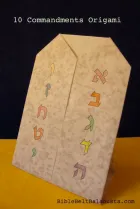
Easy 10 commandments origami

This simple paper-folding craft is a fun way to prepare for and celebrate Shavuot, the holiday that commemorates the giving of the Ten Commandments, and by extension the whole Torah.

With your help, even a young child can fold and decorate the “Tablets.”  The finished product can stand up on a table or lie flat as a card. Continue reading

Make Your Own Lego Mezuzah

Lego Mezuzah. A Simple Version

Lego Mezuzah. A Simple Version

DIY Lego Mezuzah with Kids

(Update: a revised version is now under my Make a Mezuzah: LEGO Mezuzah page.)

I’m a big fan of making mezuzah cases with kids, and especially out of found materials. In my house, Lego qualify as found material, as they are found under every large piece of furniture.

Making a ritual object out of repurposed materials with your kid is fun and Jewish (two words we like to link as often as possible), useful and meaningful. In the case of a mezuzah (pun intended), we can touch the container every time we enter a room, which gives us a physical connection to the Sh’ma prayer inside and the parent-child crafted case outside. Of course, we make sure the case is mounted low enough for kids to reach, too. (And the observant among us would have a kosher mezuzah higher up on the doorframe already. For mezuzah rules, see here.)

Other materials great for making mezuzah cases are: dental floss containers, toothbrush tubes, fat straws (from bubble tea), half a walnut shell, toothpaste boxes, plastic tubing and pretty much anything longer than it is wide and that will still fit on a doorpost. Laurie Bellet, author of The Reluctant Artist, posted a great idea at the Torah Aura blog about making cases from dried-out markers.

Do see  my Kveller.com article about making training scrolls (as in “not kosher” scrolls) with kids and about making mezuzah cases from used glue stick containers and empty matchboxes.

But why Lego?  Why not?  Lego are fantastically fun building materials. And if you love Lego, you and your kid can happily fiddle with a pile of assorted bricks and come up with all sorts of designs.

The basic requirements are that the case is: big enough to hold a scroll, has a way to open and close to insert the scroll, and has a flat back for mounting to doorpost with tape.

The flat plate base, upside down

The rest is left up to the imagination. My dream is to create a big letter Shin(the traditional decoration for any case) on the front using the tiny, single-knob round pieces, but I have so far been unable to meet this challenge.

A stylized Lego Shin

To make a three-legged Shin requires five horizontal rows of knobs, and my flat plate is only four rows wide. I made a sample Shin (at left) which could easily attach it to the front of my mezuzah, but the thick profile (I don’t have the right kind of flat plates) would protrude too far into the doorway. Continue reading

Making Toys Jewish

Dollhouse Purim teaparty

Kveller.com published my article on Converting Toys to Judaism.  Do please read it at Kveller.com and leave a comment if you have ideas to share.

What does converting toys mean, exactly?  It means we can use all the toys we already have, Jewishly.  From Lego to play kitchens to Barbies to bath toys.

Here are a few more ideas and pictures I couldn’t include in the article, plus a few quotes.

“A Jewish toy is a toy that can accessorize a Jewish story.”

Torah and Bible stories, midrashim, folktales, holiday stories and the latest PJ Library selection can all be re-enacted or embellished Continue reading

Grow Your Own Maror (after Passover)

Grating horseradish root for Chain. No, the goggles don't help.

Grating horseradish root for Chain. Annual photo op.

Passover seder has passed.

Did you buy a big ol’ horseradish root for Maror this year?

Did you toss it on the compost heap yet?

Well, run right out and pull it back off.  You can use it to grow a new one for next year’s seder. Even a small piece should take root just fine. Your kid can help you, and then proudly claim ownership at Passover.

HOW WE CAN USE IT WITH KIDS Continue reading

Passover S’mores

Tam Tam cracker s'more

Tam Tam cracker s’more

I want my kids to think Passover is fun.  What’s more fun than marshmallows and fire?

Continue reading

DIY Passover Plagues Box: the box

Plagues toy assembly line. The kids sort and fill each Box O’ Plague before each seder.

In DIY Passover Plagues Box, I gave reasons and instructions for a kid-created seder activity: a box of plagues toys. You can keep the toys in a bin and pull them out every year, adding to and tweaking the selection as your kids grow. Preferably, they do the adding and tweaking with you.

Our favorite way to store and use the toys is in a home-made Box o’ Plagues, created from an empty matzah box. Continue reading

DIY Passover Plagues Toys

assemble your own kit

DIY plague toys

DIY Passover Plagues Box and Dramatic Re-enaction

Everything about the seder is designed to teach kids. Symbolic foods, the four questions, songs, Rabbinic lessons and the many discrepancies therein: eating yet more matzah for dessert (afikomen), leaning on pillows at the table, all that dipping? But usually, seders are so long and boring not much learning goes on, except learning that seders are long and boring.

Re-enacting the plagues can make seders more educational and fun. We are commanded to think of ourselves as slaves in Egypt: toys, props and simple costumes facilitate this leap of the imagination. Continue reading

Edible Mishloach Manot Basket

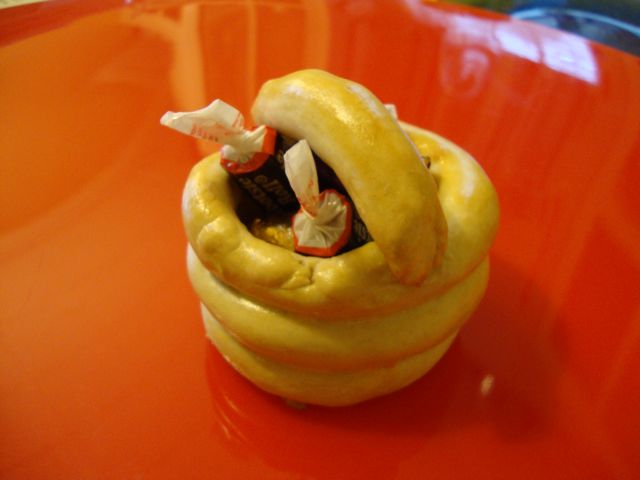
Edible Pretzel Basket for Purim

Of course the contents of a Purim Mishloach Manot basket are edible. But what if the actual basket was, too?

A Homeshuling post about kid-crafted Mishloach Manot containers that are eco-friendly, cheap and reasonably attractive utterly derailed my work schedule today.  I stopped everything to try the idea I posted as a suggestion, to make an edible basket from pretzel dough.   Continue reading

Origami Mishloach Manot for kids (with video)

origami cup + handle

origami cup + handle

Just about any origami box, bag, envelope or basket can be a Mishloach Manot container, but this one is actually easy enough that little kids can make it.

Remember the origami paper cup pattern? It’s pretty common in schools and scouts and whatnot.  This is it, plus a stapled handle. (The cup can actually hold water, as long as you don’t need it to hold water for very long…) Continue reading

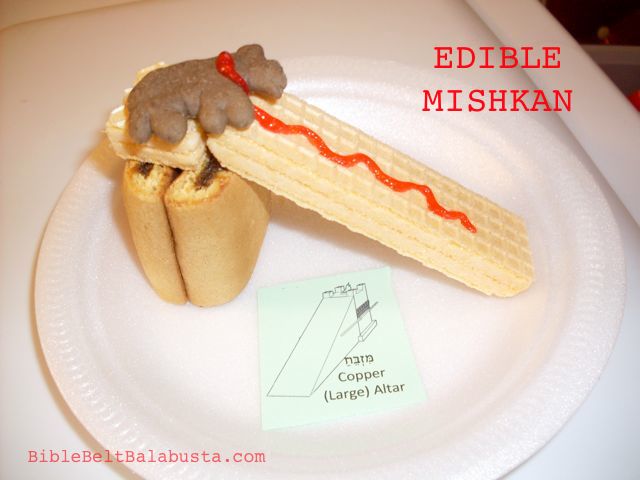
Edible Mishkan: Build (and Eat) Me a Tabernacle

Edible Mishkan - Tabernacle

copper altar . . .

Last week’s Parsha was Vayakel, the one where the Israelites build the Mishkan, the Tabernacle in the wilderness. So, for a Shabbat activity at synagogue, I created an Edible Mishkan. Each kid 2nd grade and up made a personal, edible Mishkan.

Many liberties have been taken with materials, but it was a sweet little project.

Everything is kosher. My store was out of Jelly Belly gummy bears, or they would be sitting on the ark as chubby cherubim. Continue reading

Converting Valentine candy: Mishloach Manot

Mishloach Manot

Whether or not you do Valentine’s Day at your house, there is a world of half-price Valentine candy in shops right now, and some of it can work just dandy for the next Jewish holiday, Purim.  Kisses, especially. Because of the chocolate preferences of certain grandmothers in our family, our Purim Mishloach Manot baskets always include Hershey’s kisses. Valentine kisses are usually robed in red: simple, bright, fun red.  Without the outer packaging, red kisses are deliciously generic and ready for conversion. And of course, they are kosher. (So are Tootsie Rolls, by the way, and I Continue reading

Seder Plates by Target

Seder plate at Target: cheap and cute

At Target yesterday I found an endcap full of seder dishes. This discrepant event was so discrepant I almost didn’t believe it. Five bucks for a large, melamine seder plate with shallow depressions for each symbol, and with the English and Hebrew name for each.

Hebrew at Target?

And for $1.99 you can get a coordinating square matzah plate with just the three little Hebrew letters that spell matzah.

So very surprised and happy.  Maybe melamine isn’t the earth’s friendliest material, but I am overlooking this fact in favor of the bigger fact that Target is selling dishes for my holiday.

Maybe this is a yearly occurrence where you come from, but not around here.

Todah rabah, Target.

Matchbox Mezuzah

Matchbox Mezuzah

Here’s another easy mezuzah for kids to make, but this one is genuinely pretty. We used a photocopied klaf (parchment) inside the matchbox and mounted it low enough for a preschooler to actually reach.

My three-year old made this with his dad’s help, which would not have been much help, so I believe any kid can create a sweet mezuzah with these materials. The kicker is the lovely, golden Shaddai sticker (the shin with the crown), which makes the whole thing look and feel legit. The stickers come in a sheet of 48 from Benny’s Educational Toys, and the blank matchbooks come from Oriental Trading.

I must mention that playing with matchboxes is irresistible for any age, so this is a particularly hands-on craft. I organized a Matchbox Mezuzah group project for a Shema workshop last weekend at our synagogue and the parents were just as pleased to open and close and open and close the boxes….

Need:
Tape (I used blue painter’s tape)
Blank white matchbox (or used ones if you’ve got them)
Craft sticks (I used the broad, tongue-depressor size that comes in colors)
Tissue paper squares (cut from gift wrap)
Liquid starch (or white glue) in a small bowl or jar lid
Small brush
Shema scroll (see previous post: Glue Stick Mezuzah for ideas about this)

  • First, tape the stick to the back of the matchbox. It doesn’t matter what kind of tape because you will cover it with starch and tissue in a moment.
  • Brush thin layer of starch or glue on matchbox—including over the tape—and then place individual layers of the tiny tissue paper squares everywhere except the open ends.
    Keep brushing starch and affixing layers until you or your child needs to be done…
  • Top with a crowned shin sticker if you have it, or any shin sticker. Or, wait until the box is dry and write a shin with permanent marker or rubber stamp.

The only trick is to make sure you don’t starch the matchbox shut. If you do, you can run a sharp knife through the seams after all is dry.

Glue Stick Mezuzah: or, Make a Green Mezuzah for Free

A Glue Stick Mezuzah

Here’s a new use for an empty glue stick tube: a mezuzah case. If you collect a bunch, you have a cost-free craft for a whole class.

Glue Sticks don’t last very long. Manufacturers seem to keep shrinking the volume of glue without shrinking the actual container, and the glue has a fairly short shelf life (about two years).  Thus, empty glue stick containers multiply, especially at a school.

A mezuzah is really the scroll inside of a mezuzah case: a klaf, or piece of kosher parchment upon which a sofer—scribe—has written (special ink, special quill) the first two passages of the Shema, Judaism’s central prayer.* The Shema is comprised of key verses from Deuteronomy (6:9 and 11:13-21), and begins, “Hear, Oh Israel, the Lord our God, the Lord is One.”

Mezuzah literally means “doorpost,” and it is on our doorposts that Jews are obliged to mount a mezuzah. Doing so is a mitzvah—a commandment—and, what a coincidence, it is a biblical commandment found in the Shema itself: “you shall inscribe them [these words] on the doorposts of your home.”

So, every Jewish home, or to be more inclusive, every home in which someone identifies as Jewish, needs a mezuzah on the doorposts. Home in Hebew is bayit, and the home of a mezuzah—the case—is called a beit mezuzah, or mezuzah home.  A beit mezuzah can be made out of just about any material that protects the scroll, and in every price range. This one comes in sticky plastic and is free.

Making a mezuzah case as pretty as you are able can actually Continue reading

Jewish Bedtime Rituals for families

Bedtime Sh’ma Coloring Book with your child’s photo

InterfaithFamily.com (which is a great site, by the way, full of info and ideas and community) just posted an article about making bedtime Jewish written by Chief Education Officer Karen Kushner, with a link to a free pdf booklet: “Goodnight, Sleep Tight: Jewish Rituals for Your Interfaith Family.”

I am delighted Jewish bedtime is getting attention. Transforming the nightly routine into something Jewish is easy: just add a new element or two–something that feels comfortable and genuine. Whether a family is interfaith or not: it doesn’t matter: what matters is that at least one parent is committed to making every day (and night) more Jewish.

Please see my Jewish Bedtime post for a detailed breakdown of every step of a typical bedtime progression, with plenty of suggestions about how to inject a bit of Jewishness. Continue reading